
#002
Wandering the Creative Wilderness

In my last post, I promised to get you guys up to speed and let you know what I’ve been up to since Human Target. Basically, a whole lot of everything and a whole lot of nothing. But, before I get into that, I have a few bits of business to go over first…
Commissions!
I’ve been having a lot of fun with commissions and I’m currently wrapping up the list that I opened up after the last newsletter. I’ve had so much fun, in fact, that I will be opening up my list again this Wednesday, February 19th at 2PM CT. There will be 40 spots available for a single character 9 x 12 (same price as before - $700) in my store HERE.
This will be the only time I open up my list this year but don’t worry - I’ll be doing commissions every year from here on out.
Here are a few of the commissions I recently finished:


Squa Tront!
I did five covers for the reanimated EC Comics line last year and put together a short process thread for the issue #2 cover over on Twitter HERE.
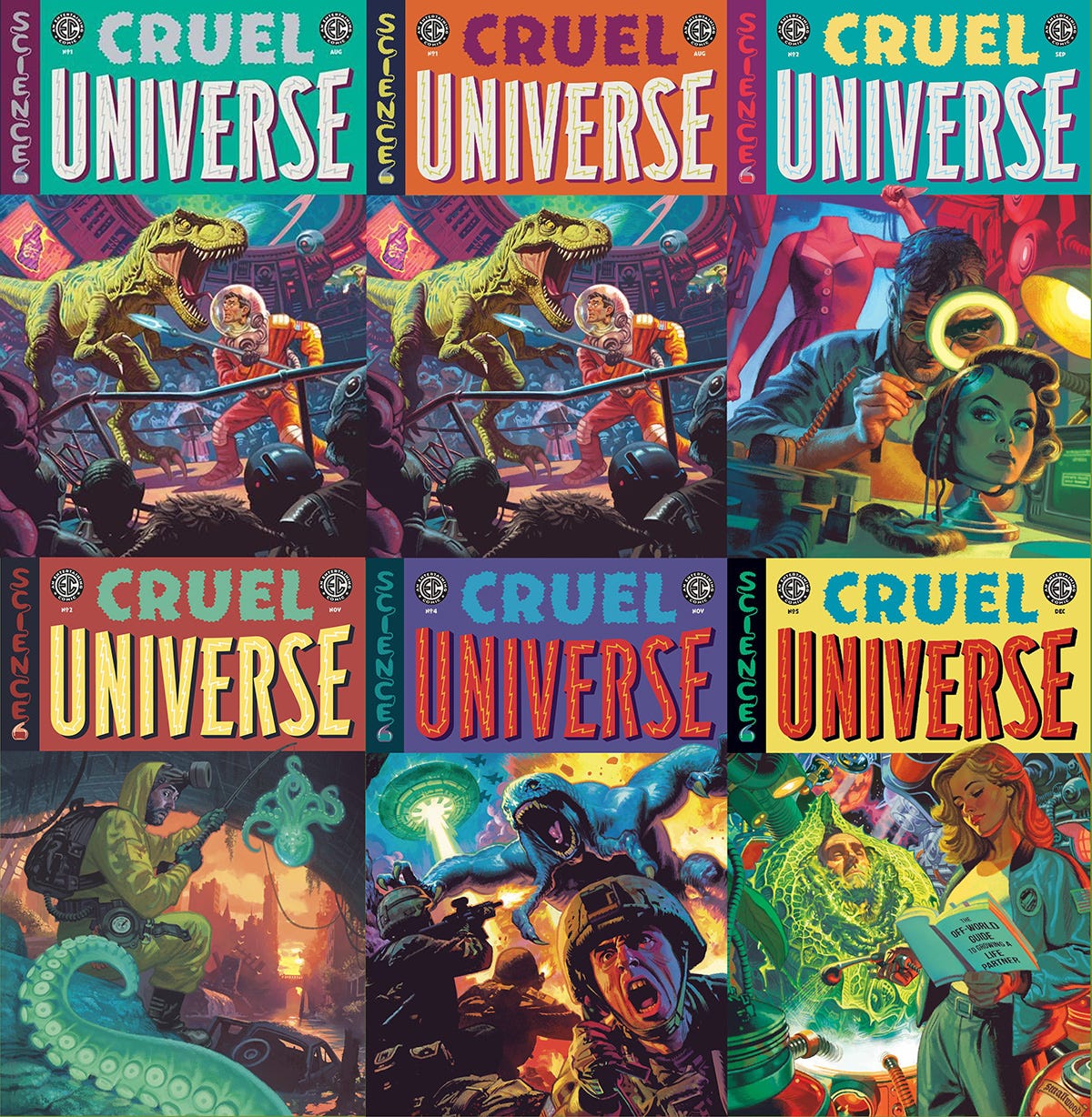
Getting to work on these was a dream. I’ve done a number of EC parodies and homages over the years so it was a trip to actually create official EC covers that get to exist alongside the classics. And that gorgeous Rian Hughes trade dress - it doesn’t get much better than this as far as cover gigs go.
Also, I’ve neglected mentioning it before now, but the folks over at Mutant turned my cover for #1 into a 24 x 36 screenprint. I have one and it’s a beauty. If you’re interested in purchasing it, you can do so HERE.
Two Years
That’s how long it’s been since I wrapped Human Target. After it wrapped, I was supposed to launch straight into an OGN, wrap that up mid-2023, and then tackle Batman the Barbarian and have that wrapped by mid-2024. I was to write, draw, and color both projects.
I normally experiment with style and technique before a project so I started looking at fantasy artists (both projects are firmly situated in the genre) and began incorporating elements of their work into mine. Frazetta, Corben, Moebius…the greats. This process usually takes a few months and I typically emerge with a few more skills under my belt. This time was…different. I became more and more frustrated with my work and couldn’t move forward. I was starting to hate everything I did but, for some reason, couldn’t just retreat back to my normal way of doing things. After a few months, I realized that I was stuck in what some have called “the learning trough”.
I first learned about the learning trough from Jesse Hamm’s writings on Alex Toth (you can buy a collection of his Toth essays right HERE). Here’s what Jesse Hamm writes about the trough:
In my occasional role as an art teacher, I've noticed a strange phenomenon. The student will learn a new technique -- hear it, grasp it, practice it a couple of times -- and then abandon it, returning to whatever mediocre approach the new technique was meant to replace. Why does this happen? My curiosity on this point led me to read of what educators have called "the learning trough." The learning trough is a period in which the student becomes temporarily less capable than usual, in order to master a newly learned skill. For instance, a typing student who formerly relied on the hunt-and-peck method will find herself typing more slowly while she attempts to master the (ultimately faster) method of touch-typing. The learning trough stands in contrast to the more familiar learning curve, in which students progress more rapidly in the initial stages of learning. This is because the learning curve results from additive learning: the student is adding knowledge where none existed -- whereas the learning trough results from supplantive learning: the student is attempting to replace flawed knowledge with better knowledge. This is an important distinction. It means that additive learning rewards the ego, while supplantive learning punishes the ego. Beginners exploring wholly new territory (additive) are spurred on by their relatively quick initial success, but advanced students who find themselves in the learning trough (supplantive) tend to rush back to the more familiar territory of mediocrity, because doing the wrong thing well is less embarrassing than doing the right thing poorly. The learning trough is even scarier for professional artists, whose reputation and livelihood depend on appearing skillful. "I have deadlines to meet, clients and fans to impress… I can't take a break from all that to master some unfamiliar method." And so they plateau. To be sure, every artist will happily add a new trick to his bag when one appears -- just not when doing so means trading away an old standby, and briefly floundering.
This phenomenon was not new to me but I’d never been stuck in this phase. I was so lost in other art styles and techniques that I didn’t even know what my style was or how to recognize it. I couldn’t maintain any type of consistency; it was like being an amateur artist all over again, desperate to find my “style”. Strange place to be as a professional. So, to make ends meet, I embraced my discombobulation and began taking on work outside of comics where I could just focus on keeping things consistent for one piece of key art or a single painting for a trading card. Hard to do for a whole comic but easier to pull off for a one-off illustration.
The plus side to all of this was that I finally got to see what life as an illustrator was like outside of comics. I’ve often received work offers for non-comic work but I usually turn it down because the grind of interior work and covers is too demanding. But with my comics projects going nowhere, I started taking on jobs with companies like WB animation and Wizards of the Coast. And oh boy, can I see why we lose so many comic pros to other industries. Not only are the folks who work at these companies sharp and professional but the paychecks are several leagues above what you get in comics. It’s also fun to jump around from a book cover to a poster to a trading card. Hard for the work to turn stale when it’s so varied.
Comics (specifically interiors) is a grind and it’s hard to make a living at it unless you’re fast. And most artists aren’t fast. For every Chris Samnee and Daniel Warren Johnson, there are ten of us slow guys who often take so long on a page that it shrinks our hourly rate down to below minimum wage. When the siren call of animation comes, I can see why it’s difficult to resist.
But don’t you worry. I’m not looking for greener pastures; I belong here in the dirt that is funny books. I truly believe that comics are the ultimate DIY artform — immediate, raw, and personal. Nothing beats finishing a comic and then seeing it in a reader’s hands just a month later. You can’t get that with film or animation. Comics are a beautiful blend between pulp and folk art where there are no limits to the types of stories you can tell or the art style you use to tell it. No middle men - just the artists and the audience.
So where am I at with Batman the Barbarian? I’m getting there…slowly. I’m currently trying to re-learn how to do pages traditionally (and at a reasonable pace). It’s been hard to maintain any consistency when I work digitally but my traditional work still feels like Greg Smallwood to me. Commissions have been incredibly helpful in this regard. I guess that digital allows for so many options and choices and redoes that I often get lost in the weeds and bogged down for days (the downside to working in a medium with minimal limitations). Working traditionally is training me to work concisely and commit to each line and mark.
In a perfect world, you wouldn’t even know I was working on Batman the Barbarian yet. But since you do know, I assure you that you will see it finished someday soon — I’m committed to finishing it. I’m blessed to have incredibly patient editors who let me take my time with the work and I’m equally blessed to have readers who are just as patient. Thank you!
Unfortunately, I can’t show you most of what I’ve done for the past two years but there is one piece I did for WB Animation that made it out into the wild
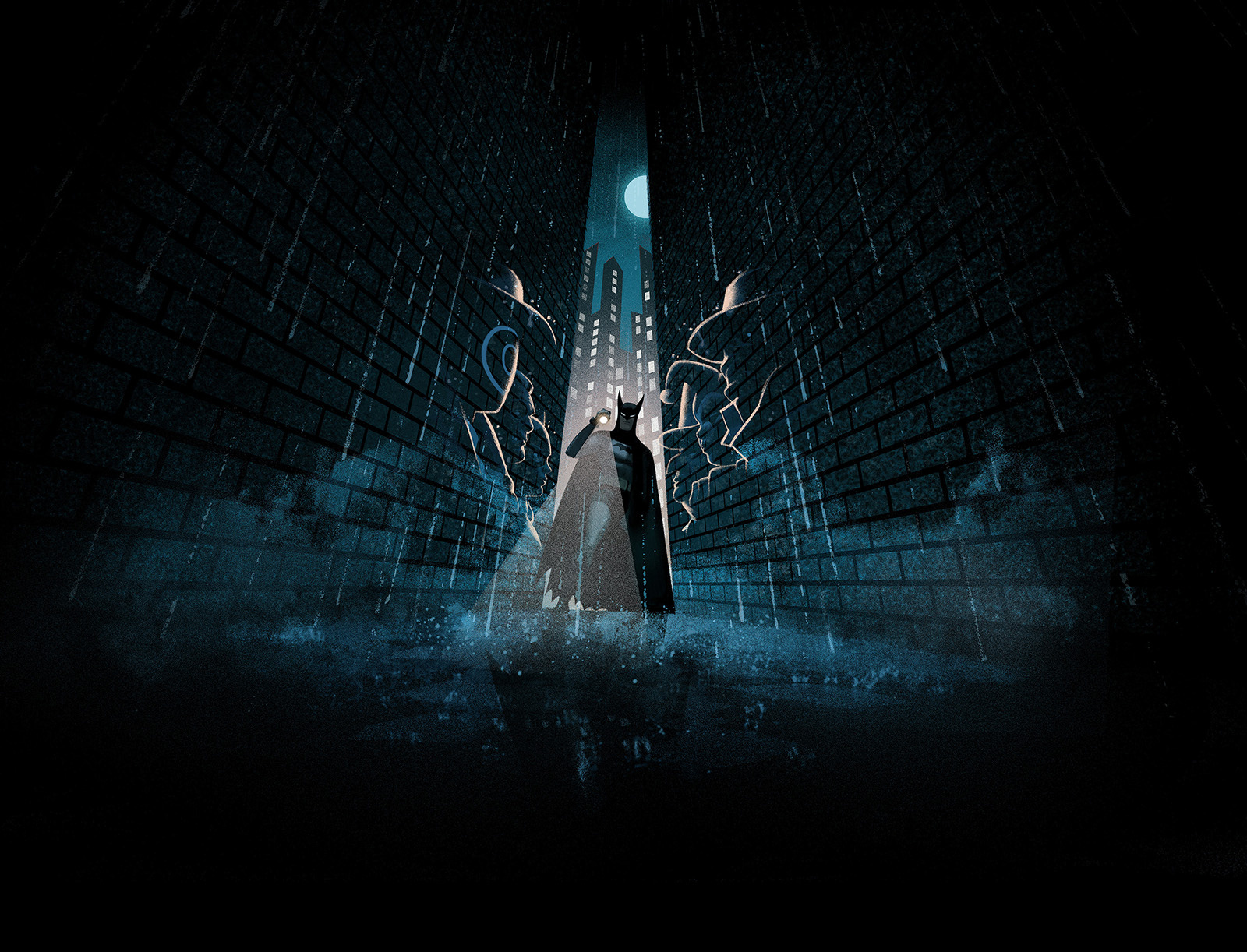
I did this as a multi-layered file where every element was on it’s own layer and could be moved around or adjusted. WB made their tweaks to it and it eventually made it’s way to magazine covers, billboards, and the Amazon Prime app itself.


More of the work I did will trickle out over the next year or two but some of it is locked behind NDAs and the like. Fortunately, my favorite work from the last two years (the Cruel Universe covers) is out there for everyone to see.
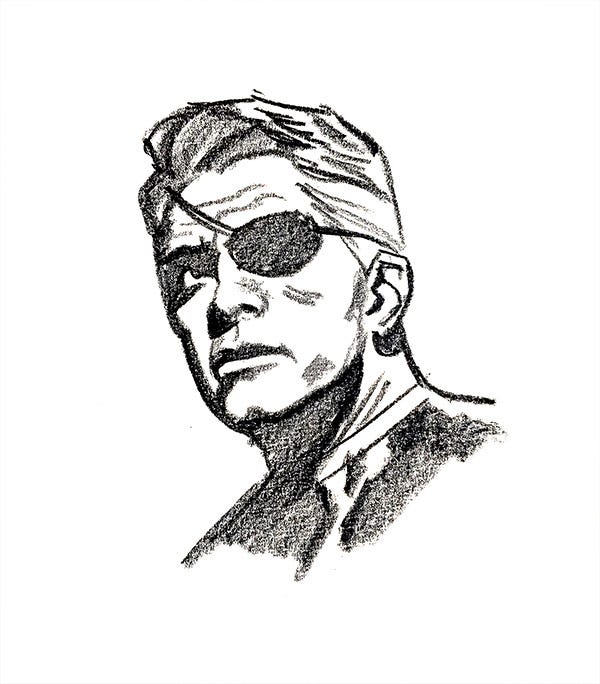
That’s it for now. For #003, I’m going to go over my process behind the best comic I’ve ever made — The One-Eyed Gambit. Stay tuned!
Thank you for sharing this! It is always cool to read about an artist's experience. Glad you are taking your time with comics.
Great read, Greg! Very interesting. Does this mean you are working traditional on Batman the Barbarian? Also, what happened with the other project you were planning? Thanks and sorry for all the questions!